Driving to Santa Teresa, Costa Rica, by ferry or the long way round?
The 3:00 pm ferry pulls out of Puntarenas on schedule, with you or without you. Get stuck behind a truck on Route 27 and you're waiting for the 6:00 pm sailing, which means driving the curves from Paquera to Santa Teresa in the dark.
Santa Teresa is close to the southern tip of the Nicoya Peninsula, a long way from both international airports. The route you choose shapes your first evening (a sunset beer on Playa Carmen, or searching for your rental's driveway by phone flashlight).
Which route makes sense from SJO or LIR?
Your airport decides it. Land at San José and the ferry is your road, but land at Liberia (or drive down from a beach week in Guanacaste) and Route 21 takes you all the way around by land.
|
Starting point |
Route |
Rough door to door time |
Ferry |
|
SJO Juan Santamaría |
Route 27 to Puntarenas, boat to Paquera, then on through Cóbano |
About 5.5 hours |
Yes, roughly 70 minutes of crossing |
|
LIR Liberia |
Route 21 through Santa Cruz, Nicoya, Naranjo and Paquera |
4.5 to 5 hours |
No |
|
Samara along the coast |
Dirt track with several river crossings, dry season only |
Longer than the map suggests |
No |
Waze and Google Maps will sometimes push that coastal track on you. Ignore them. Cars have been swept away in those rivers, and drivers who stepped out to gauge the water at one of the final crossings before Santa Teresa have been robbed.
How the Puntarenas to Paquera ferry works with a car
Departures run from both Puntarenas and Paquera at 4:00 am, 6:30 am, 9:00 am, 12:00 pm, 3:00 pm, 6:00 pm, 8:00 pm and 10:00 pm. This timetable started on April 20, 2026, and it gets reshuffled now and then, so look at it again the week you travel.
Fares are ₡11,400 for a standard car (around $23) plus ₡810 per adult, with 13% VAT added. Over Christmas, New Year and Semana Santa the boat sells out, which is when booking online pays off.
The booking site is Spanish only. Choose "Vehículo Liviano" for a rental, and if the agency hasn't given you a plate number yet, enter "Rental Car" and show your receipt at the ticket office.
Finding the dock in Puntarenas is simple once you know it. Stay on Avenida Central until the point runs out, turn right, and park in the lot next to the yellow gate about 45 minutes before departure.
Tickets are sold at the window across the street, cash only, and they refuse $50 and $100 bills (break a big note at the airport). You'll also meet a few guys who jog over to "help" you park. They want a tip for it.
Boarding works differently than most people expect. The driver takes the car on alone while passengers walk up the ramp, and nobody can go back down to the car deck once you're moving, so carry the passports with you.
And download your e-ticket before you leave Puntarenas. Coverage around Paquera is awful.
Up top, the wind off the Gulf of Nicoya steals hats, and plenty end up in the water. The galley below serves gallo pinto early and casados later in the day, so the 12:00 pm crossing doubles as lunch.
One more trap sits right in the same port. The Naranjo ferry goes toward Samara and Nosara, not Santa Teresa, so check which boat you're queuing for.
The arrival day math
Route 27 gets you from SJO to the Puntarenas dock in about 2.5 hours, not counting immigration, luggage and the rental desk (have at least $8 in small colones ready for tolls). Landing at 11 am leaves you scrambling for the 3:00 pm boat.
What if you land at 2 pm? Then it's the 6:00 pm sailing and 53 km from Paquera to Santa Teresa after dark, about an hour or longer if you drive carefully.
But skip that plan. Spend the first night near the airport or in Puntarenas, catch the 9:00 am ferry, and you'll reach town in daylight with most of the afternoon left.
Dust, dirt and why a 4x4 earns its keep
Older forum threads still describe a dirt slog to the coast. You can ignore them, because as of 2025 the main roads from both San José and Liberia are paved the whole way.
The trouble starts at your hotel's turnoff. A lot of rentals are perched on the steep slopes above the main road, and you reach them by rutted dirt tracks that no county crew has graded in a while.
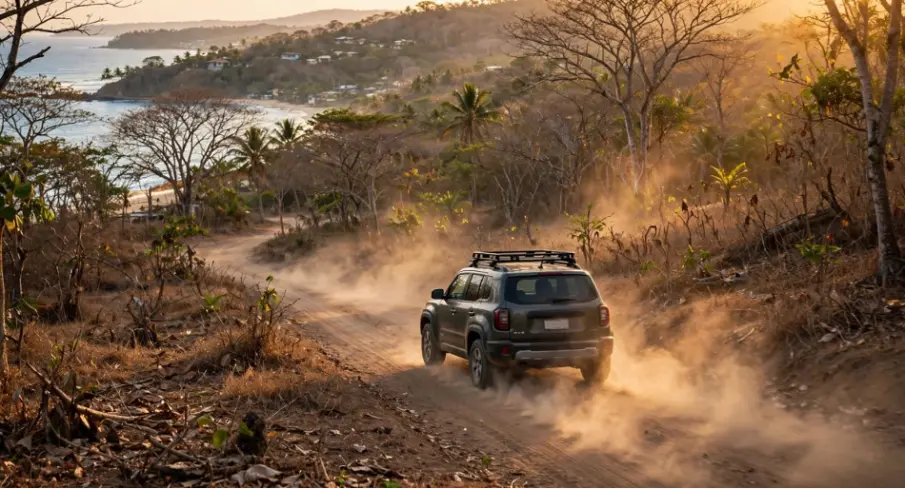
In the dry season that means dust. March is scorching, and every ATV that rattles past throws up a fine brown cloud that settles on the car, on your bags and on you (keep the windows up and the AC on recirculate).
And from May to November those same tracks break up into potholes and mud on the climbs. That's exactly where a 2WD car sits there spinning its wheels while you wonder who to call.
A regular sedan will probably get you into town on the main road. But will it get you up a wet hill to a villa with a view? Ask your host that before you book the car, and ask for a straight answer.
Fuel catches people out too. The southern peninsula has one station in Paquera and two in Cóbano, nothing else, so fill the tank in Cóbano on your way in.
For an airport pickup I'd pick a local company that already drives these roads. Jumbocar rental car costa rica has agencies near SJO and LIR with a free shuttle from the terminals, and the mandatory insurance is already in the price they quote you. Their fleet covers the Suzuki Jimny, the Suzuki Vitara and a 7-seat Mitsubishi Montero 4x4.
They also handle one-way rentals. That's handy if you'd rather land in Liberia, drive down Route 21 and fly out of San José after taking the ferry across.
|
Your plan |
Car that fits |
|
Couple staying in town on the main road in the dry season |
A compact 4x2 such as the Geely Coolray is enough |
|
Hillside villa, or any trip between May and November |
Suzuki Jimny or Vitara 4x4, since the extra clearance helps over ruts |
|
Family traveling with surfboards and luggage |
Kia Sportage auto 4x4, or the 7-seat Montero |
Santa Teresa, Mal País and Montezuma once you're there
The whole strip hangs off a single road. It starts at the fishing village of Mal País, passes El Cruce (the junction where the Cóbano road comes down at Playa Carmen), carries on through Playa Santa Teresa and ends up at Playa Hermosa, a 10 to 15 minute drive north.
Most people pick their beach by the surf, and that's the right instinct here. Playa Carmen gives you a long right breaking over sand with softer rips, which is why the beginners and longboarders cluster there.
Keep driving north and Playa Santa Teresa turns faster and steeper. Its point breaks, Suck Rock being the famous one, work best at low tide. Playa Hermosa mellows out again. And the reefs at Punta Barrigona and Sunset Reef in Mal País are a different story, shallow and only switched on by a big swell, so unless you surf well you should watch from the sand.
Mal País itself stays quiet. The road runs about 5 km before it stops at Cabo Blanco, and Playa Cuevas is worth a snorkel at low tide.
You'll see a mountain road on the map linking Mal País to Cabuya. Don't take it. For most of the year it's barely passable even in a 4x4, and the detour through Cóbano and Montezuma costs you less time than getting stuck would.
Give Montezuma a full day. Just south of town the falls have a main drop of almost 80 feet (24 meters). Boats also leave from the beach for Isla Tortuga, where the water is calm enough to swim in, something you can't say for Santa Teresa.
Where to stay
Sleep in Playa Carmen or Playa Santa Teresa and you'll walk to dinner, but you'll also hear the main road. Mal País and Playa Hermosa trade that convenience for quiet.
For a sense of prices, Zula Inn goes for $66 to $215 a night and Lua Villas in Playa Hermosa for $80 to $240. Up the Mal País hillside, Hotel Vista de Olas sits at $185 to $250, while Hotel Nantipa, right on the beach, starts at $330.
FAQ about getting to Santa Teresa
Where do you fly into for Santa Teresa, Costa Rica?
You've got two options, SJO in San José or LIR in Liberia. Plan on about 5.5 hours from SJO with the ferry included, or about 5 hours from LIR with no ferry at all.
Is it better to fly into San José or Liberia?
Liberia, for most people. The drive is a bit shorter and you don't plan around a ferry timetable. San José only wins if the Central Valley is on your itinerary too.
Do you need to reserve the Paquera ferry?
Usually not. Show up at the dock 45 minutes early and you can buy there. But during holiday weeks like Christmas and Semana Santa, book online and grab the return ticket in the same go.
When is the best time to visit Santa Teresa?
The surf runs all year, so it comes down to what you'll put up with. Dry season means dusty roads and a brown forest. From May to November everything turns green and the dirt tracks turn to mud, which is exactly when a 4x4 earns its rental price.